
Strange that the things that have stayed in my memory concerning my school days at Toowoomba Grammar have not been academic endeavours, such as they were, or any of the other serious matters for which my father was paying out good money to keep me there as a boarder, but rather, the escapades that some of the boys, including, at times, myself, got into. The Oxford dictionary defines an escapade as ‘ a breaking loose from restraint; a flighty piece of conduct.’ Boarding School was, of necessity, a place of restraint. The majority of the boys submitted to it but there were always some who did not. These might be termed ill-disciplined, rebellious, disobedient, disrespectful of authority or by any other appropriate epithet; maybe, these terms did describe some. But, for the most part, these were rarer spirits who, knowing the rules and the sanctions that were attached to the breaking of them, nevertheless prized their individual liberty and, in their thirst for excitement, were willing to balance the risk of being caught and its attendant painful consequences against the thrill of being free.
We were still living in a man’s world, between the two World Wars- in a patriarchal society- and boys were treated as men in the making. Boarding School was not only a place of academic learning, but, as a microcosm of the wider society, a place where a boy was being trained to take his place in the adult world. He was learning manly values; to take his knocks on the football field; to shake down with other men in a male society; to recognise and respect the virtues of honesty, truthfulness, fortitude and fair dealing and to shun such things that do not ‘become a man’-deceiptfulness, cunning, cowardice, self-servingness, disloyalty and the like. And alongside all this, he was taught respect for women. Old habits die hard, developed as they were through home and school training. I still find myself raising my hat to a woman, standing up if a woman enters the room and offering my seat to a woman in a train or a bus. Usually I am told to sit down, my offer being interpreted as a patronising gesture. The modern woman abhors any implication that she is in any respect inferior to the male and the modern man seems to be prepared to treat her as his equal and quite happily lets her stand.
But all this is having little bearing on the title to this treatise-‘The Saturday Book’. This was an exercise book, suitably ruled, that was kept in the Masters’ Common Room. In it were recorded the names of boys who, during the week, had been awarded a Saturday detention. This may have been for some mis-behaviour in class or for neglecting to complete an allotted task. The Saturday had to be worked out under supervision at School between 9 a.m. and 12 noon on the forthcoming Saturday and, on the preceding Friday assembly, the names of the miscreants were solemnly read out from the platform by one of the masters. There was a further dimension. If a boy earned two Saturdays in the one week, not only did he have to work them out on consecutive Saturdays, but he also earned himself a visit to the Headmaster’s study where he collected the further imposition of two to four lashes across his backside from the boss, affectionately known as ‘Harry’. ‘Slim Jim’ was a longish lawyer cane with a reaping hook bend towards one end from being frequently bent around a succession of boy’s posteriors. ‘Fat Jack’ was shorter, fatter and with no bend. Each of them hurt, their sting being like a thousand needles but most boys preferred ‘Fat Jack’ because he had a more accurate trajectory and his stripes could be confined to the area that was protected by the football pants hidden under the outer trousers.
On this week, Tudberry II (he had a twin brother at school who was Tudberry I), Wolf and Frizzell each has three Saturdays recorded before Friday. This was serious business. ‘Harry’ would not be in a good mood nor did the prospect of three consecutive detentions please. Some decisive action was needed and needed quickly. On Thursday night, when all were asleep in their respective dormitories, these three arose like ghosts, dressed, crept down to the Masters’ Common Room and stole the Saturday book, thereby conferring a blessing not only upon themselves but also on the other boys whose names were recorded for that week- an unmerited favour that was duly acknowledged in the Friday assembly when no Saturdays could be read out. With their ill-gotten gain safely secured by one of them our three musketeers stole down to the bike-shed, appropriated three bikes owned either by boarders or by day-boys who had not taken them home, and rode through the night some twenty miles to Wolf’s farm where, in the dead of night, the sods with their bayonet’s turning, by the misty moonbeams ghostly light’ they buried, not Sir John Moore, but the Saturday Book.
Then they rode back and arrived just before breakfast. With sheepish looks they took their respective places at table but, before the repast was over, the ‘buzz’ had gone around the room and their nocturnal exploit and the blow they had struck in the name of freedom became common knowledge.
At the time, no one thought it unusual that they had ridden forty miles to accomplish something that might just have easily been done within the confines of the school’s 50 acres. But boys don’t think with an adult’s logic. For sure! That Saturday Book was dead and gone, buried, not in the sea of God’s forgetfulness, but just as surely, never to be remembered again. What puzzled the masters who conducted classes on the Friday, and delighted the boys who were in them, was that, one after the other, at various times and in various classes, Tudberry, Wolf and Frizzell dozed off to sleep in the middle of the lesson and had to be prodded each time into wakefulness. For this exploit, if for no other reason, their names have lived for evermore in the memories of their school mates.
Sadly, two of them have an even wider memorial. Bill Tudberry was killed on the night of 29 June 1944 in an attack against the railway yards at Blainville and Metz, and Cecil Frizzell died on 5 December 1943 when his Lancaster crashed on take-off at Waddington in England. Both were Air-Gunners serving with RAF Bomber Command.

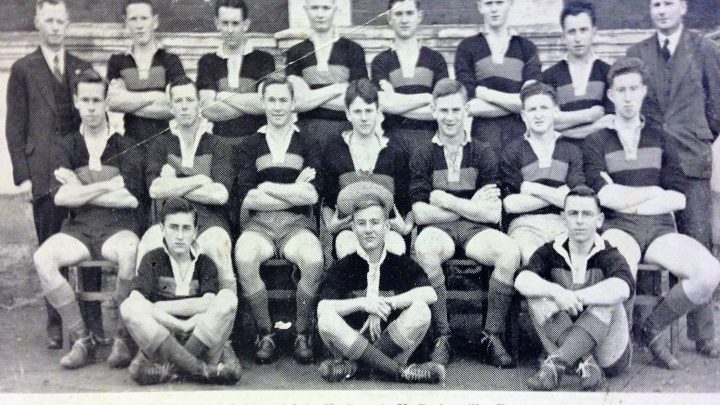
Toowoomba Grammar 2nd XV Rugby 1940