
Page 21


Jo and I went to Ashford when I was 13 and she was 12. We were day girls for two years travelling back wards and forwards by train from Maidstone to Ashford. There was a little group of us Sheila McCabe, Bridget, and Pat Moore. In our final year together in the lower IV Sheila and I set our caps on the School Scholarship (2 were awarded). I did very well coming top in every subject (except Maths…!!) But we had a Brain-kid in Lower III that year. We were all 14 but this girl was only 12 and she beat me to 2nd place by one point and my friend in Alfred: Prue Petch – later to go to Oxford and become a writer – was 1st.
At this time my father was finding
Page 22


Page 22
the financial burden of two girls at a public school hard to underwrite. My mother buried her pride and wrote to Uncle Guy (who was childless) and asked for a little help.
He not only help but undertook to pay our fees as borders for the next two years so I started the Lower V as a border and enjoy the next two years of my life to the full.
I had been confirmed that year in the Church of England by the Bishop of Dover. I had being well prepared for the service, understanding that I was now making an open confession all my faith in Jesus Christ. As the Bishop laid his hands on my head I knew that experiential meaning of the” Wind blowing where it listeth) so is everyone that is born of the Spirit of God”.
As a border I enjoyed Holy Communion every Sunday at 7 AM. Bridget was always there also the School Principal Miss Brake. We gathered in the hall at Alfred and she insisted we all had a glass of milk and a piece of bread and butter before we left.
Miss Brake (Anglican) and Miss Edwards (Baptist) had started Ashford primarily for children of missionaries and later expatriate English who wished their daughters educated in England.
As a Boarder I was allocated to Toda (Hebrew for “Praise”) dormitory in Somerville House.(Mrs Edwards was one of the first women graduates from Somerville College in Oxford as BSc – but NO degree given because she was a woman!)
Page 23


Page 23
In Toda dormitory I met Jean Davidson later Jean Woods when she married Tony Woods ex Naval officer and good friend of Jo’s husband David Edmondson. Tony went on to become Queen’s Accountant with the title “Keeper of the Queen’s Privy Purse” with a lovely part of Kensington Palace as a home. I stay there with Jean and Tony in the 1970 when I went to UK on my own. They are now Sir Tony and Lady Jean Woods and live at The Old Forge in Norfork.
Jean was also the niece of Ray Mitchell, the apple farmer from Maidstone and a member of the AOG. Ray play a large part in encouraging my mother in her Christian walk in later life.
Ashford School (1937-1940)
Ashford school was a recognised Public School for Girls. It had pupils from Primary School to Upper VI (1st year university subjects). The School Council consisted of men of distinction and academic excellence. It was a Christian School with the Gospel continuing presented under an Academic umbrella of Scholastic achievement.
The Archbishop of Canterbury was a trustee and Board member also Lord Brabourne – Mark Doleman and other Kentish identities. I was at school when Lord Brabourne’s son was in the Prep School. He later married Lord Mountbatten’s daughter and was the man who was badly injured (with his wife)-his young son kill and another young Irish lad-when
Page 24


Page 24
Mountbatten was blown up off the Irish coast by a planted bomb activated onshore by the IRA (what Brave-Brave creeps!).
The school was started by “Gran” Edwards in the 1920’s. She was a Christian lady (a Baptist) and had gone up to Oxford to read science and mathematics in the late 1800’s. She lodged at Sommerville and graduated from her course with some distinction. At the time degrees were only conferred on men so in a sense Gran Edwards was well ahead of her time. For her time in Oxford (3 years) she received no official recognition from the Faculty. She married and went to live in South Africa with a missionary husband.
She used to share with me some of the trials of a Minister’s wife. When she arrived a house had been provided and decorating and finished in very garnish style. She tried to tastefully simplify her surroundings only to be criticised for her efforts. In the end she had to learn to live in such jarring surroundings. Even her wedding ring was criticised. Surely a lesson to be observed and learned here by all of us.
After some years in the Cape and 2 children to raise, Mr Edwards developed Parkinson’s disease. The Edwards family returned home and “Gran” put her university training to good use founding AHS (Ashford High School)
Page 25


Page 25
initially as a boarding school for missionary children-and later as the reputation of the school grew-for expatriate English families who wished their daughters to be educated in England.
“Gran” then commence to surround herself with hand picked teachers. Lillian Brake (a friend of Rupert Brooke) was one of them. Lillian Brake became “Head” after Gran and was always known as “Cherub” because of her blue-blue eyes – glowing pink face and warm smile to everyone. Both women set a fine Christian example and left an everlasting mark on my life.
The School was set on a very large property either side of the main road through Ashford. The river Wye meandered along the 2 hockey fields behind “Brooke” House and we could put boats on the river whenever we wish. On the main side of the School property was Alfred House an early Victorian country house. The “Liberty” room for “Liberty girls” was in Alfred a lovely large timber – vaulted room with tables and comfortable chairs and a roaring fire in cold weather. The Prefects room was also in Alfred and the Head had her private apartment there. After we became Prefects we used to join Cherub in her Chintz-covered lounge every
Page 26


Page 26
evening to talk with her-have hot chocolate and listen to the 9 PM news on the wireless. We would all be in our pyjamas and it brings back wonderful memories of good friendship. There was always a little God Bless Prayer before we left and a “Good night chicks” and a hug all of us.
Sommerville (where I slept) had all (4) the Lower V classrooms on the ground floor. The Corination wing housed the Library, the Science Block and Upper IV rooms . Crammer (where Joe slept) had the classrooms of Upper V (3) and also the small Upper (VI) – (certain approved subjects of first year university).
We also had a lovely swimming pool where Cherub swam everyday winter and summer, a skating rink, three netball courts, two hard court Tennis and about six Grass courts-another hockey pitch-extensive grounds and lawns. There was also an Art Centre and a Craft Centre and a Central Dining for Crammar and Sommerville. Alfred and Brooke dined in their own residences.
All the day girls were in Chancer House, so this was my introduction to high school as a day-girl at Chancer.
My father drove Joe and myself to the station every day where we
Page 27


Page 27
met Sheila McCabe and Bridget Griffiths and it took about 40 minutes to Ashford. We walk from the station to the school in time for the first lesson missing out (with permission) the daily Assembly.
As I entered Lower V, Joe and I became borders with due thanks to Uncle Guy. I went into residence at Somerville and Joe to Crammer. Where she became best buddies with Jean Edmondson later to become her sister-in-law. I loved every minute of it, and became involved in every aspect of school life. I did well academically and in another timeslot what have gone to Oxford or Cambridge. I won sports colours in Netball being in the Schools No.1 team and travelling around all the other Girls Public Schools for matches. One of them was Beneden where Princess Anne was sent some years later. I played Hockey for the School and was very involved with gymnastics and became very proficient (we had a marvelous gym and gym coach). I learn to ballroom dance, I took part in plays in Gilbert and Sullivan operettas and was very involved in Art in Design, Colour etc. (Got a Distinction in my Entrance Exam to London University!).
I made some wonderful friends. Daisy Cockburn from Singapore – a brilliant swimmer – fast and beautiful to watch.
Page 28


Page 28
Dorothy Still from Malaysia-a Diver-Joyce Atkinson from Cyprus-a great skater and a very good friend. Joyce Payne from Shanghai China, Joyce Hanland from Shanghai China (also a member of the 1st Netball). Doris Turner from Canada, Valerie and Mary Glassborough from France. Prue Perch from Hong Kong – a good gymnast-went to Oxford. Mary Leferre from Canteberry-of the Leferre’s large Kentish Retailers. Doreen Irwin from Kent
We also had two Jewish refugees from Germany (this was pre-war). Jewish families in Germany would choose one member who’s call in life was to survive. They were both in our year. One was Erica Flack-as German as “Hansfraus” as you could ever see and the other Rachel Fielden(??) as Jewish as you imagine with dark frizzy hair – olive skin and a hooked nose. Both were wards of the Archbishop of Canterbury an old “pal” of Cherubs.
Then came 1939 and war. I had spent a week in an apartment at Bexhill in Sussex and on the coast with my friend Joyce Atkinson. Her mother (a Cyprus lady) was in the UK on holidays and Joyce and I enjoyed a wonderful week together. I remember well the day
Page 29


Page 29
War broke out. We had been issued with gas masks and when the PM announced we were at war, Joyce and her mother and myself got our gas masks and went to the basement. The “All clear” sounded half an hour later. There were no enemy aircraft around-only an unidentified plane. The next day I caught the double-decker bus back to Maidstone. I have never forgotten how I felt as I got on the bus and said goodbye to Joyce. It was a physical painful severance that I actually felt. Her mother was planning to leave for USA shortly after and we both knew we would never see each other again.
It was just the first of many such goodbyes in my life-but that first one at 16 was hard. I never heard from Joyce or ever saw her again. Maybe a U-boat got them, I’ll never know.
We were back at school in 1939 for the phoney war of “Hanging out the washing on the Siegfried Line. It was the beginning of my final year at school and I want to do well. I had been on the Liberty list for some years and enjoy the tremendous privileges of trust which it extended. Gran introduced the idea to A.H.S. and all of the educators in those days howled her down-but it worked.
At 14 one’s name was put forward to the Liberty list. All the Liberty girls at that time would vote for
Page 30


Page 30
or against your maturity to be on such a list. If you passed that – your name then went forward to the staff and Head Prefects – then finally to Cherub.
As a Liberty you had all the Liberty you could wish (providing you remain within the well-drawn-up rules of behaviour).
For example, you could go boating after school, swim, playing tennis, do where ever you want, in the sun, by the pool, in your room. On Saturdays you could go up town and shop, go to the pictures and much much more. We had a book and all that was required was you sign in and out with times and had to be sure you went where you said you were going. It taught me the meaning of liberty with responsibility. They are inseparable experiences.
In 1939 I became a Prefect, I was in the 1st Netball, I was attending the Sutton Valence Balls with the S.V. boys either at Ashford or S.V. I was playing hockey, doing gymnastics and setting my sights on an academic career at Oxford with hopes of working in the British Museum or something similar.
But in 1940 Germany invaded Holland, Belgium and France and UK experienced Dunkirk.
I well remember the day all my friends from Asia left for home. Their
Page 31


Page 31
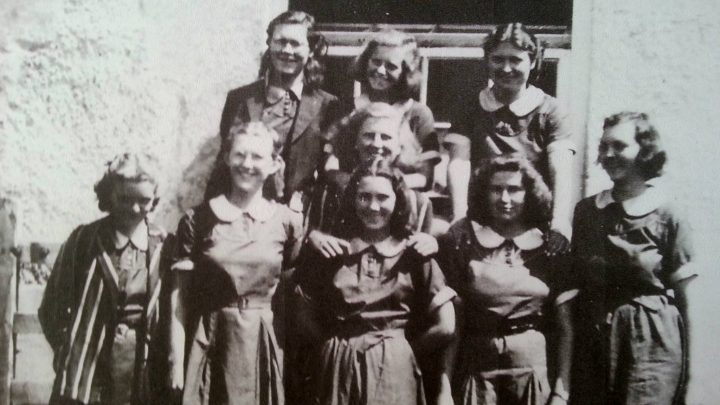
parents must have chartered a flying boat and all the Far East girls left school in a matter of hours. I have a snap of our tearful and sad little group so suddenly torn apart. All the girls from Shanghai and Malaysia and Singapore went back to internment by the Japanese for the rest of the war. I never heard from them again.
I remember when the Glassbrough’s knew their parents were fleeing ahead of the German push into France. They didn’t know if they were dead or alive. I recall the day they were called out of class (The terrible feeling of not knowing if they were dead or not) And – they were THERE at the school. We all wept. Their Dad was in the Diplomatic Corps and they spoke French like natives.
Soon the skies over Britain and especially Kent were dark with German aircraft and then came May 1940 and Dunkirk. We were all called out of class to Assembly where we were told of Dunkirk – of the miracle of 350,000 men returning and of the fact that school was closing that day and we were all going home that day or the next. It was as as quick as that and Joe and I returned to Turkey Court in June 1940 with my matriculation due in July 1940 and the Battle of Britain started. I really thought my school life was over.

1936 Ashford School

1937 Ashford School

1937 Sommerville House Ashford School

1940 Ashford School